
How much does a padel court earn in Prague?
A profitability analysis of Prague's padel centres
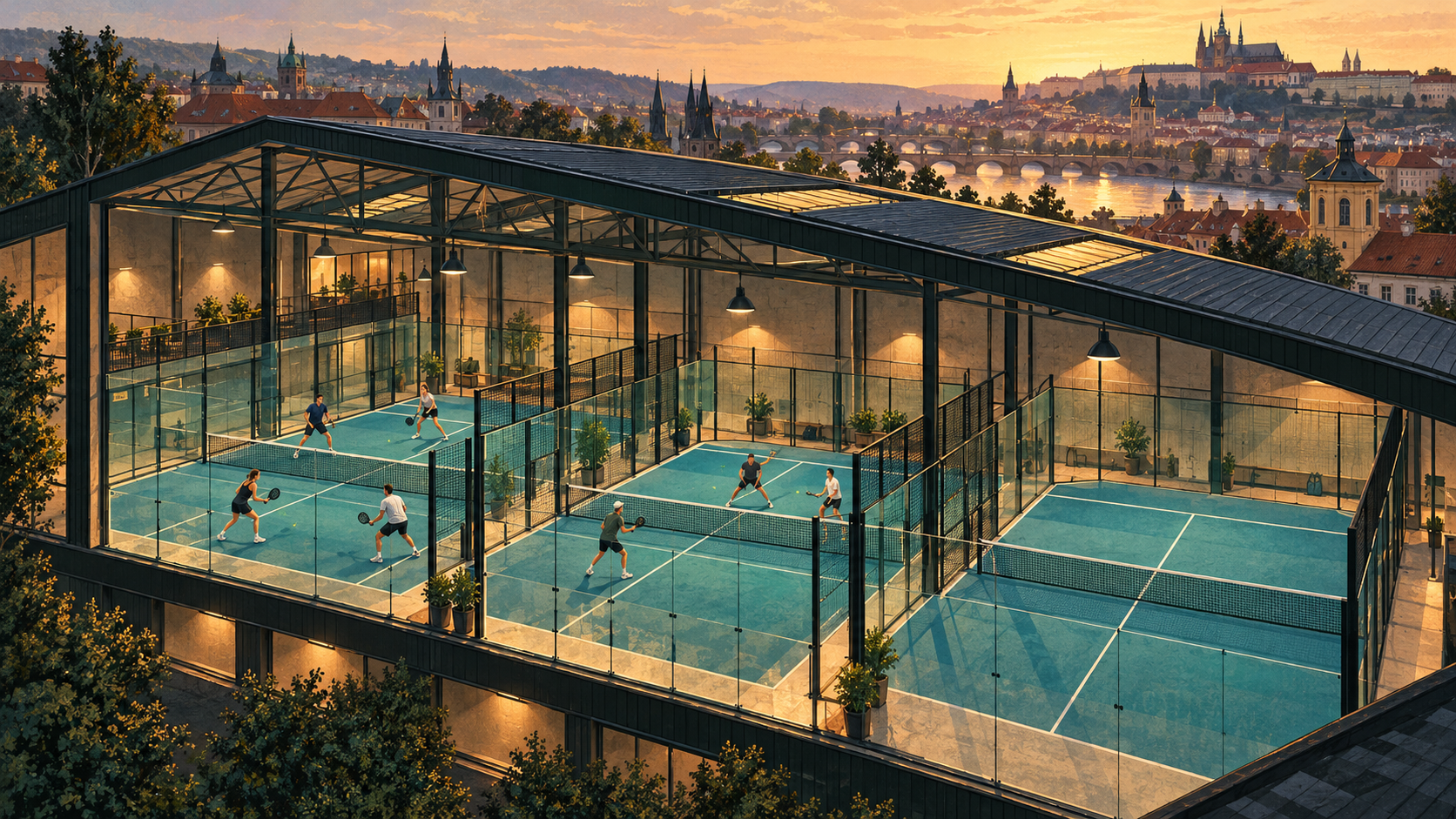
An indoor padel court in greater-central Prague is almost always full at peak. But how much is that in actual money? We took September 2026 — a full month of live availability data from 17 clubs and roughly 65 courts — and worked out how many hours were actually played, at what prices, and when. All told it comes to ~12,100 court-hours played and an estimated ~9.0 million CZK in gross revenue for the month. Padel Powers Smíchov alone is 27% of that.
How we read this. "Revenue" below is an estimate of gross merchandise value (GMV): list price × hours played, derived from publicly available booking calendars. It is not audited turnover — it excludes discounts, memberships, VAT, and income from coaching, the bar, rentals and events. The cost and investment figures later in the text are a modelled estimate, not numbers from the clubs.
How much one court earns
The range is enormous. The busiest courts in Prague earn almost 300,000 CZK a month (Padel Powers Smíchov), the weakest around 35,000–55,000. The median indoor court sits around 100,000–140,000. Earnings come down to a simple product: utilisation × price per hour.
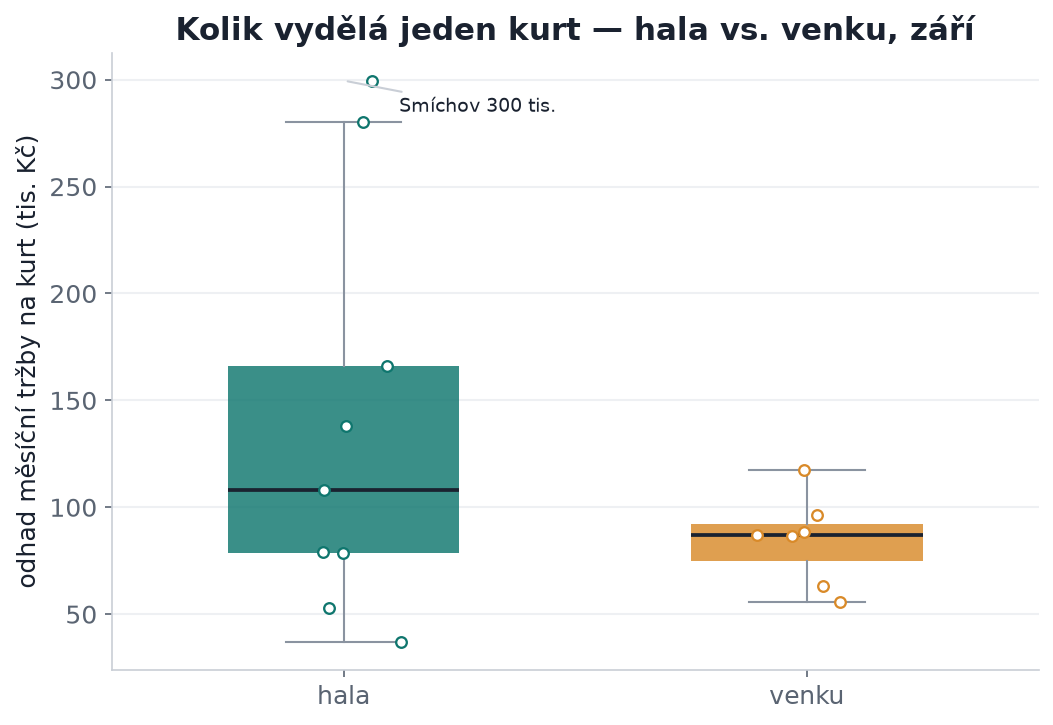
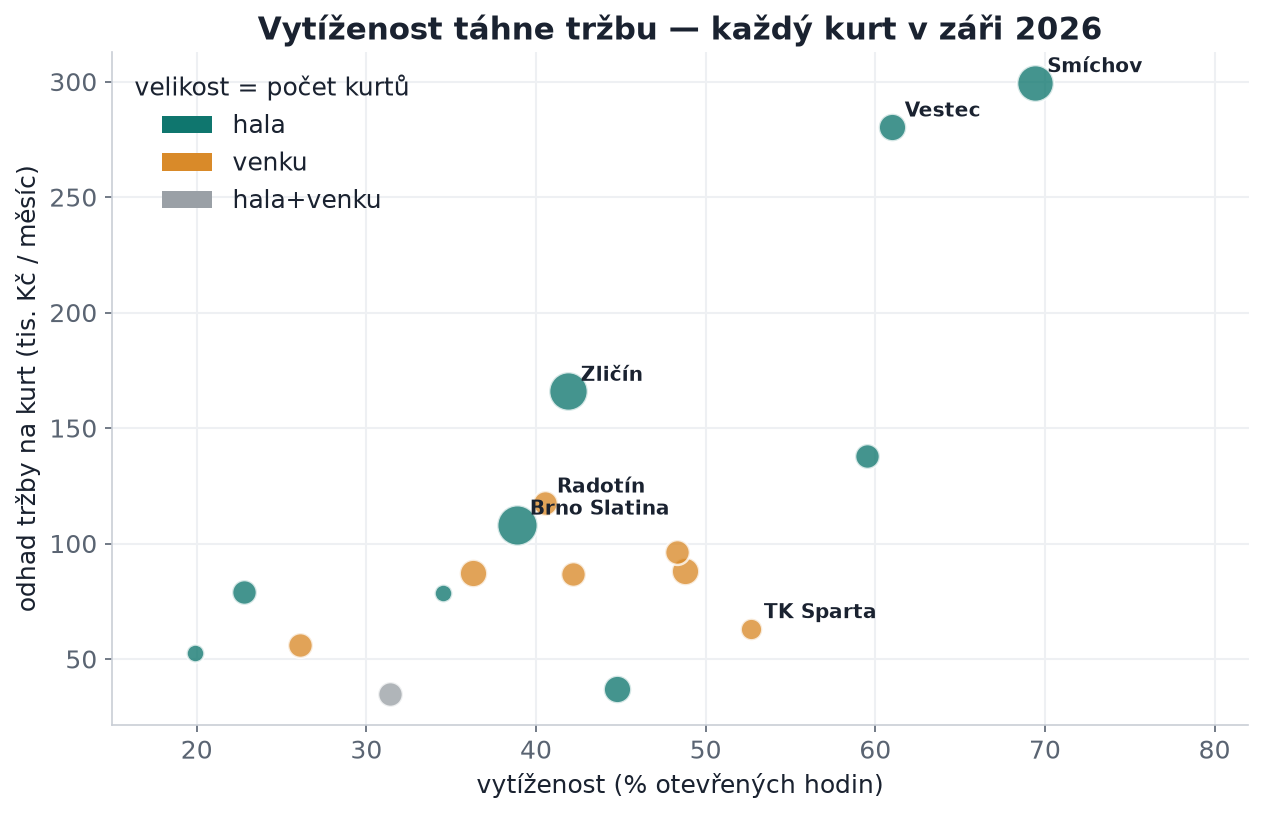
Indoor halls charge more (median 731 CZK/h vs. 606 CZK/h outdoor, a fifth higher) and have the higher top end too. But watch out — size alone doesn't guarantee profit. Padel Powers Brno Slatina has 10 courts, but at 39% utilisation earns just 108,000 per court. The four-court Tennis Centrum Head Vestec runs at 61% and makes 280,000 per court. A small, full hall beats a big half-empty one.
A tale of two halls: Smíchov vs. Zličín
Two indoor Prague clubs, almost the same realised price (883 vs. 850 CZK/h on average) — and yet Padel Powers Smíchov earns 80% more per court than One Padel Zličín (300k vs. 166k). The whole answer is in utilisation (69% vs. 42%) and above all in when they fill up.
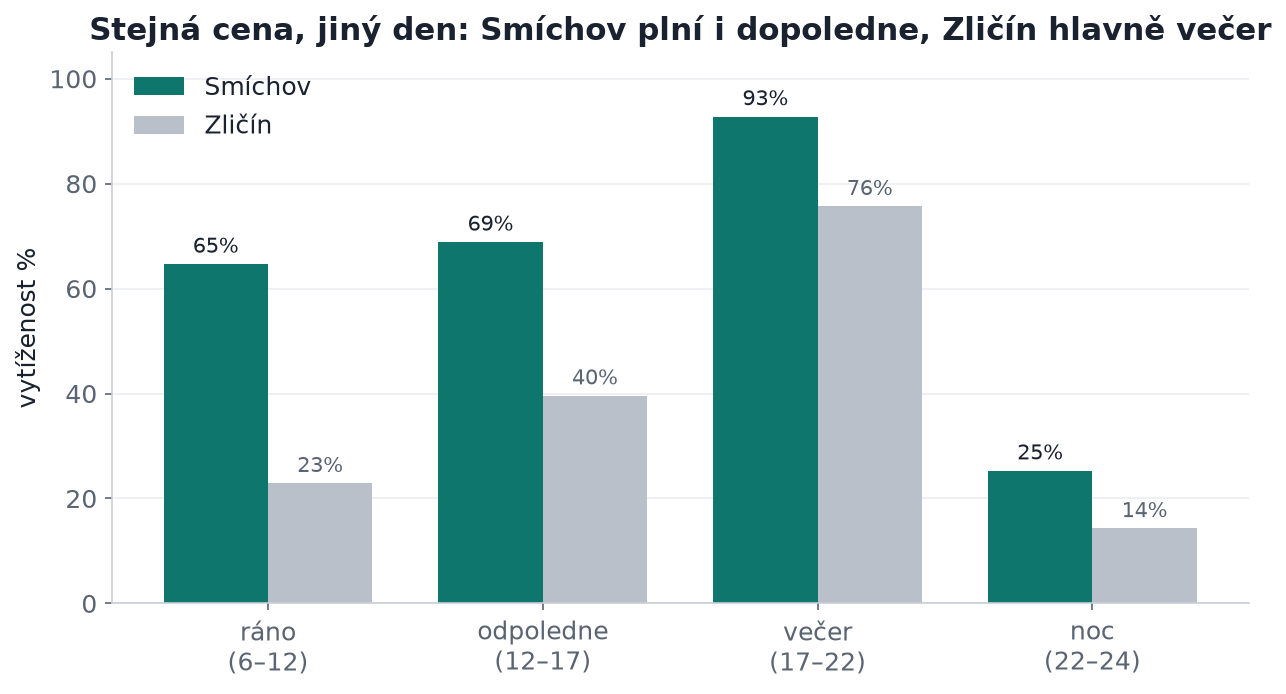
Both have full evenings: Smíchov 93%, Zličín 76%. The difference is time of day. Smíchov also fills in the morning (65%) and afternoon (69%) — Zličín's mornings are empty (23%). In other words: Zličín isn't missing the peak, it's missing the whole day around it. And prices reflect that. Smíchov not only charges more in the evening — it also differentiates by court: an hour runs roughly 800 to 960 CZK depending on the time of day and whether the court has a recording camera. Zličín, by contrast, held a flat 850 CZK all day in September, the same for every court.
What does a week at a top club look like? Here's Smíchov, hour by hour:
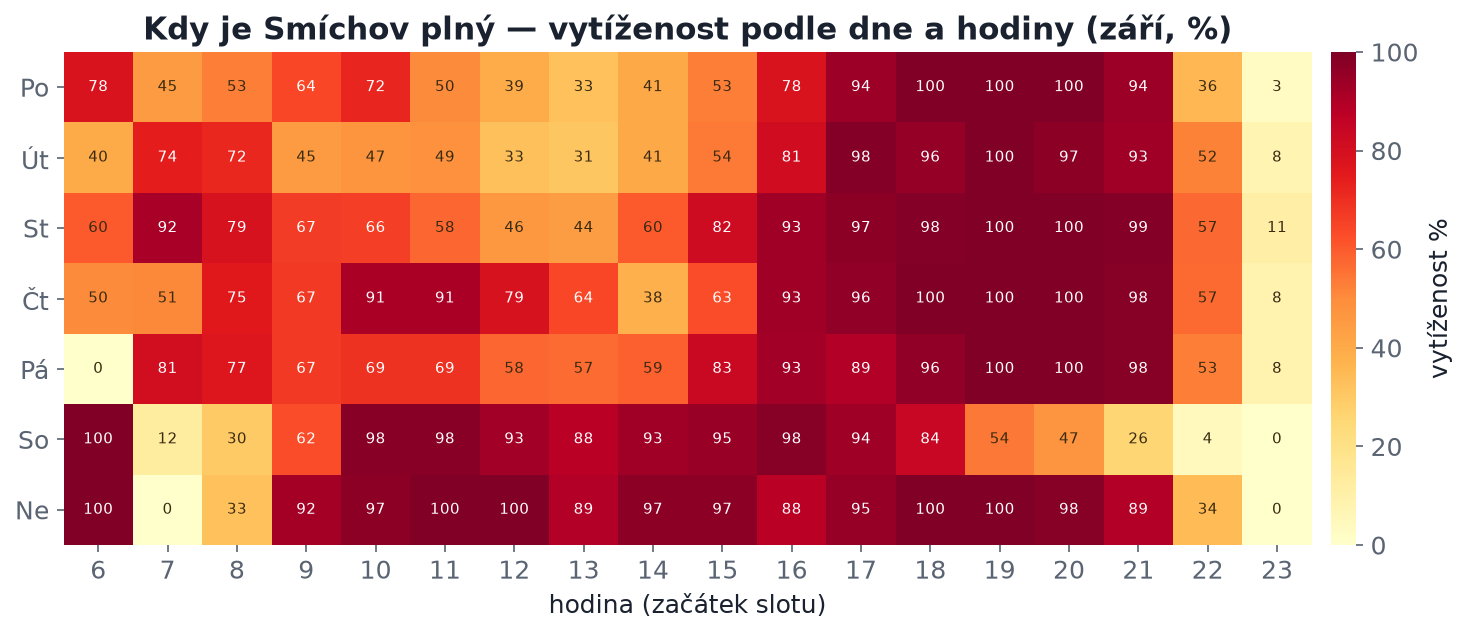
The 5–9 pm band glows near 100% across the whole week, with weekend mornings joining in. That's the "invisible" revenue that half-empty halls leave on the table.
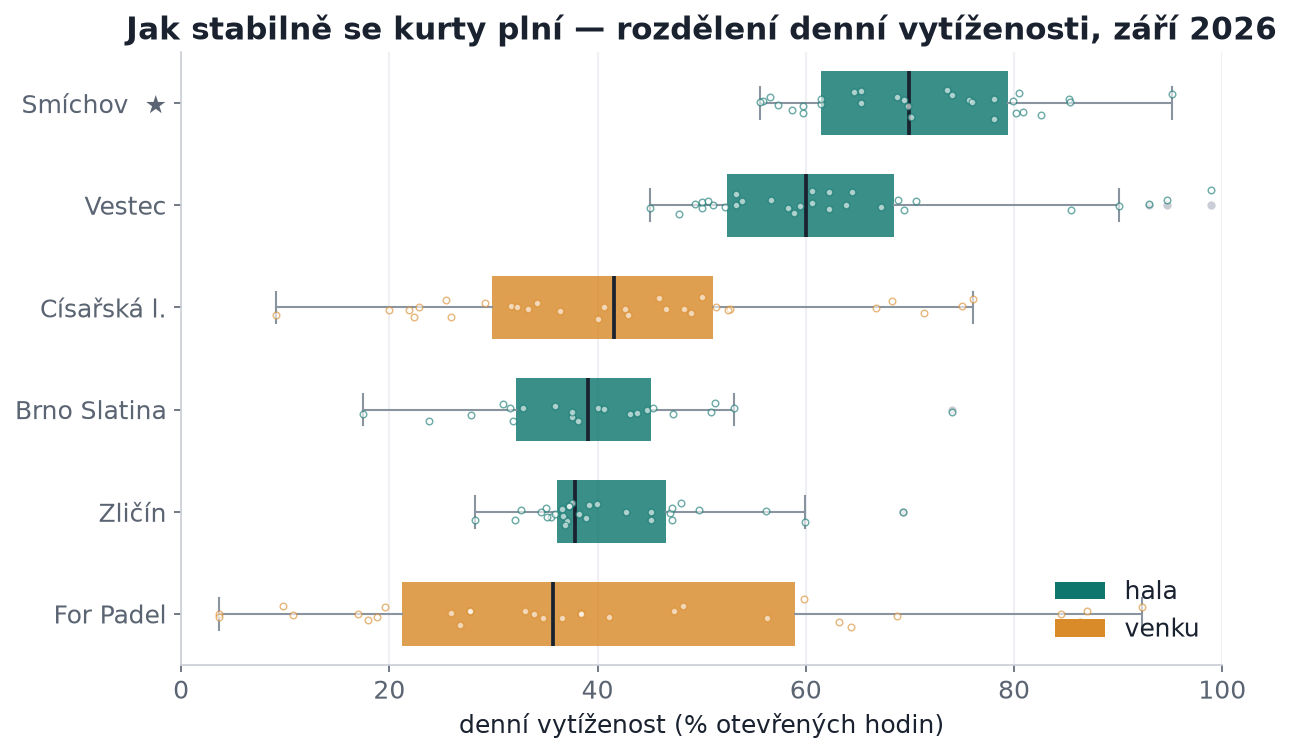
And one more view — not the average, but the distribution of daily utilisation. Smíchov is not only high but stable (62–95% day to day); outdoor clubs like For Padel Zdiměřice or Padel Císařská louka swing far more, because the weather has a say.
Indoor vs. outdoor, and seasonality
In September, indoor and outdoor utilisation were almost identical (44% vs. 42%) — it was still warm. The hall's edge this month is price, not occupancy. The real difference comes with the season: in October the outdoor clubs collapse (For Padel from 36% to 13%, Císařská from 42% to 25%), while Smíchov holds its ~70%. A hall doesn't mean more players — it means resilience.
TK Sparta shows the cheaper route: they converted two tennis courts into outdoor padel. The base cost is far lower, and yet the club runs at 53% (71% at weekends) at a friendly 554 CZK/h. For an owner with an existing site, it's the fastest way into the game.
From revenue to profit
Revenue is half the equation. The other half is capital and operating cost — and here we're firmly into estimates.
Smíchov leased a brownfield site through 108 Real Estate — 3,300 m² on a 10-year lease — for 8 indoor courts (~410 m² per court, back-of-house included). Zličín is run directly by One Padel s.r.o., which leases the hall and fitted it out itself with 9 courts, open daily from 7 am to midnight (07–24).
- Investment per court (fit-out in a leased hall): roughly 1.65–3.0 million CZK (median ~2.3m). The court system alone — glass, steel, surface, lighting — is only 0.8–1.1m; the rest is the building and shared facilities. Zličín (9 courts) thus runs ~15–27m, Smíchov (8 courts) ~13–24m.
- Monthly operating cost: on the order of 1.0–1.6 million CZK (rent, 9–11 staff, energy, platform, insurance, marketing).
Put that together with the revenue data and you get:
| Est. revenue / month | Est. EBITDA / month | Margin | |
|---|---|---|---|
| Smíchov (Sept) | ~2.4m CZK | ~0.6–1.1m (median ~0.84) | ~39% |
| Zličín (Sept) | ~1.5m CZK | ~ −0.35 to +0.25m | ~0% |
At September's pace Smíchov pays itself back in roughly 1.3–2.4 years — which is why that operator is expanding (Brno, Ostrava and more). Zličín was around break-even in September on court rental alone; the higher rent of a bigger hall is probably its biggest burden. But the indoor season tips it into profit — and Zličín responded with pricing too: in October it dropped the flat 850 CZK and introduced dynamic pricing (890 CZK base, 990 CZK at peak) — exactly the yield management Smíchov has used from the start. Volume jumped at the same time. Same hall, from zero to profit in a few weeks.
What makes a court profitable
The data is clear: fill the day, not just the evening; price the peak; and take the hall for resilience, not for summer. And the market is still young — new courts appear every month (The Court in Jinočany, Padelmanie in Chodov) and the perimeter is stretching well beyond Prague, into Liberec and Ostrava. Whoever gets the operating model right now is building on a growing base.
Methodology: estimates are based on CourtNow data — publicly available occupancy collected throughout September 2026. "Revenue" is gross merchandise value at list prices, not audited turnover; investment and cost figures are a modelled estimate. Happy to refine the model once we add real hall sizes and rent levels.